Noisy conditional sample paths
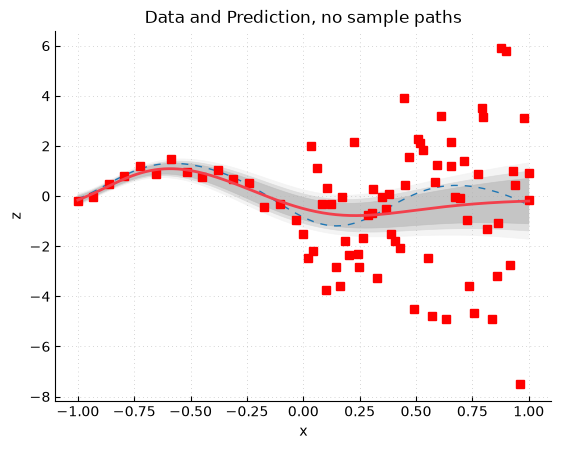
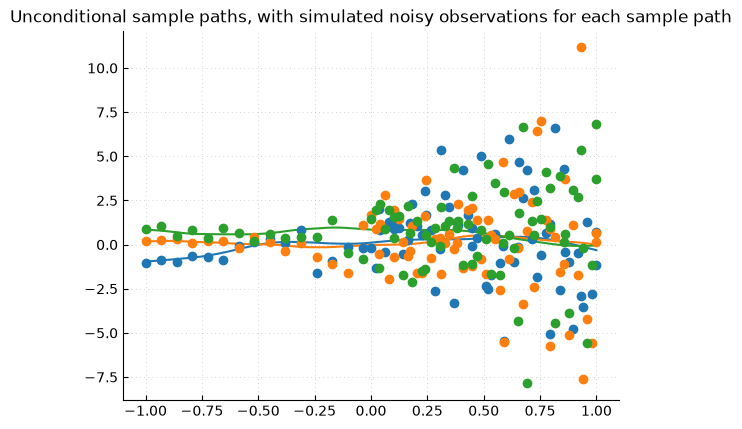
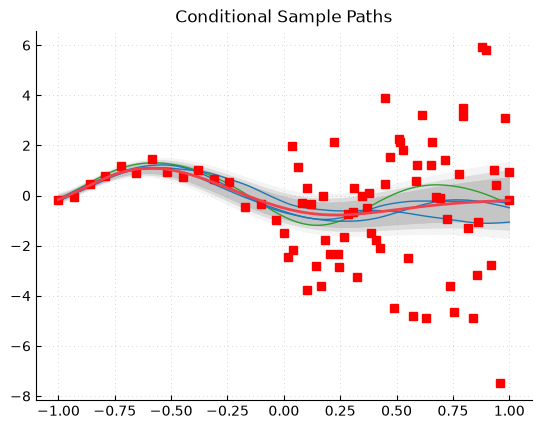
This example generates conditional sample paths in a regression setting with heteroscedastic observation noise. It extends the previous sample-path example by distinguishing noisy measurements from the latent process.
What this example does
The script defines input-dependent observation noise, computes the latent posterior distribution, and draws conditional paths compatible with noisy observations. The covariance includes the observation-noise term where needed, while predictions and paths target the latent process.
Mathematical description
The noisy observation random variables are
with \(\tau_i^2\) depending on the observation location. The array zi
stores realized noisy values \(z_i^{\mathrm{obs}}\). The conditional
distribution of the latent process at prediction points is computed with
the observation covariance. Let \(K_{ii}\) be the covariance matrix with
entries \(k_\theta(x_i^a,x_i^b)\). Then
The conditional paths target \(Z_t=Z(x_t)\), not \(Z_t^{\mathrm{obs}}\). They therefore need not pass through the noisy realized observations.
Outputs
The first output is the latent posterior distribution. The following outputs are conditional paths and posterior simulations. Because the observations are noisy, conditional paths are not required to pass exactly through observation values. Instead, they remain statistically compatible with the noise model.
Functions used
Heteroscedastic noise is represented through the covariance construction.
Conditional simulation remains a GP conditioning problem once the covariance has encoded the correct observation-noise structure.
Compare with Conditional sample paths to see the practical difference between noise-free and noisy conditioning.
Script: examples/gpmp_example11_sample_paths_noisy_obs.py
  1"""
  2GP Conditional Sample Paths
  3
  4This script demonstrates Gaussian Process (GP) regression with conditional sample paths
  5on heteroscedastic noisy data. It generates synthetic data using a predefined test function (two bumps)
  6and adds heteroscedastic Gaussian noise to the observed points. The script then constructs a GP
  7model using a Matern kernel and a constant mean function. It generates sample paths from the GP
  8prior, and then generates conditional sample paths given the observed data.
  9
 10Copyright (c) 2022-2023, CentraleSupelec
 11Author: Emmanuel Vazquez <emmanuel.vazquez@centralesupelec.fr>
 12License: GPLv3 (see LICENSE)
 13"""
 14
 15import math
 16import numpy as np
 17import gpmp.num as gnp
 18import gpmp as gp
 19import gpmp.plot as gpplot
 20
 21
 22def generate_data():
 23    dim = 1
 24    box = [[-1], [1]]
 25
 26    nt = 200
 27    # build a regular grid and evaluate the test function
 28    xt_ = gp.misc.designs.regulargrid(dim, nt, box)
 29    zt = gp.misc.testfunctions.twobumps(xt_)
 30
 31    # extend xt so that the second column is the noise variance
 32    xt = np.hstack((xt_, np.zeros((nt, 1))))
 33
 34    # observations
 35    noise_std_func = lambda x : 0.1 + (x + 1)**2
 36
 37    xi1 = gp.misc.designs.regulargrid(dim, 30, box)
 38    xi2 = gp.misc.designs.regulargrid(dim, 50, [[0], [1]])
 39    xi_union = np.vstack((xi1, xi2))
 40    ni = xi_union.shape[0]
 41
 42    # Calculate the noise standard deviation for each observation point
 43    noise_std = noise_std_func(xi_union)
 44
 45    # Add the noise variance (noise_std**2) as the last column of xi
 46    xi = np.hstack((xi_union, noise_std**2))
 47
 48    # Evaluation results with heteroscedastic Gaussian noise
 49    u = np.random.normal(size=(xi.shape[0], 1))
 50    zi = gp.misc.testfunctions.twobumps(xi_union).reshape((-1, 1)) + noise_std * u
 51
 52    return xt, zt, xi, zi
 53
 54
 55def kernel_ii_or_tt(x, param, pairwise=False):
 56    """Covariance of the observations at points given by x
 57    Parameters
 58    ----------
 59    x : ndarray(n, d + 1)
 60        Data points in dimension d. The last column is the noise
 61        variance at the location.
 62    param : ndarray(1 + d)
 63        sigma2 and range parameters
 64
 65    """
 66    p = 2
 67    sigma2 = gnp.exp(param[0])
 68    loginvrho = param[1]
 69    noise_variance = x[:, -1]  # Extract noise variance from the last column of x
 70    noise_variance = gnp.asarray(noise_variance)
 71
 72    if pairwise:
 73        # return a vector of covariances
 74        K = sigma2 * gnp.ones((x.shape[0], )) + x[:, -1]
 75    else:
 76        # return a covariance matrix between observations
 77        K = gnp.scaled_distance(loginvrho, x[:, :-1], x[:, :-1])
 78        K = sigma2 * gp.kernel.maternp_kernel(p, K) + gnp.diag(noise_variance)
 79
 80    return K
 81
 82
 83def kernel_it(x, y, param, pairwise=False):
 84    """Covariance between observations and prediction points
 85    """
 86    p = 2
 87    sigma2 = gnp.exp(param[0])
 88    loginvrho = param[1]
 89
 90    if pairwise:
 91        # return a vector of covariances
 92        K = gnp.scaled_distance_elementwise(loginvrho, x[:, :-1], y[:, :-1])
 93    else:
 94        # return a covariance matrix
 95        K = gnp.scaled_distance(loginvrho, x[:, :-1], y[:, :-1])
 96
 97    K = sigma2 * gp.kernel.maternp_kernel(p, K)
 98    return K
 99
100
101def kernel(x, y, param, pairwise=False):
102    if y is x or y is None:
103        return kernel_ii_or_tt(x, param, pairwise)
104    else:
105        return kernel_it(x, y, param, pairwise)
106
107
108def constant_mean(x, param):
109    return gnp.ones((x.shape[0], 1))
110
111
112def visualize(xt, zt, xi, zi, zpm, zpv, zsim, zpsim):
113    fig = gpplot.Figure(isinteractive=True)
114    fig.plot(xt[:, 0], zt, 'C0', linestyle=(0, (5, 5)), linewidth=1)
115    fig.plot(xi[:, 0], zi, 'rs')
116    fig.plotgp(xt[:, 0], zpm, zpv)
117    fig.xylabels('x', 'z')
118    fig.title('Data and Prediction, no sample paths')
119    fig.show(grid=True)
120
121    ni = xi.shape[0]
122    nt = xt.shape[0]
123    xixt = np.vstack((xi, xt))
124    xi_ind = np.arange(ni)
125    xt_ind = np.arange(nt) + ni
126
127    fig = gpplot.Figure(isinteractive=True)
128    fig.plot(xixt[xt_ind, 0], zsim[xt_ind])
129    fig.ax.set_prop_cycle(None)
130    fig.plot(xixt[xi_ind, 0], zsim[xi_ind], 'o')
131    fig.title('Unconditional sample paths, with simulated noisy observations for each sample path')
132    fig.show(grid=True)
133
134    fig = gpplot.Figure(isinteractive=True)
135    fig.plot(xixt[xt_ind, 0], zt, 'C2', linewidth=1)
136    fig.plot(xixt[xt_ind, 0], zpsim, 'C0', linewidth=1)
137    fig.plot(xi[:, 0], zi, 'rs')
138    fig.plotgp(xt[:, 0], zpm, zpv)
139    fig.title('Conditional Sample Paths')
140    fig.show(grid=True)
141
142
143def main():
144    xt, zt, xi, zi = generate_data()
145
146    mean = constant_mean
147    meanparam = None
148    covparam = gnp.array([math.log(0.5**2), math.log(1 / .7)])
149    model = gp.core.Model(mean, kernel, meanparam, covparam)
150
151    zpm, zpv, lambda_t = model.predict(xi, zi, xt, return_lambdas=True)
152
153    ni = xi.shape[0]
154    nt = xt.shape[0]
155    xixt = np.vstack((xi, xt))
156    xi_ind = np.arange(ni)
157    xt_ind = np.arange(nt) + ni
158
159    n_samplepaths = 3
160    zsim = model.sample_paths(xixt, n_samplepaths, method='svd')
161    zpsim = model.conditional_sample_paths(zsim, xi_ind, zi, xt_ind, lambda_t)
162
163    visualize(xt, zt, xi, zi, zpm, zpv, zsim, zpsim)
164
165
166if __name__ == "__main__":
167    main()