Example 02: models, diagnostics, and prediction
Complete script: examples/example02_models.py
Purpose
The script builds a Matérn container, select covariance parameters, compute predictions, run diagnostics, and visualize the result. It includes a one-output one-dimensional problem and a two-output two-dimensional problem. Matérn covariance functions and likelihood-based parameter selection are standard tools in GP interpolation [2, 9]. Empirical comparisons of selection criteria are discussed by Petit et al. [6].
What is computed
selected covariance parameters for each output.
posterior means and variances on prediction points.
conditional sample paths for the one-dimensional case.
leave-one-out predictions and LOO error plots.
reference-versus-prediction plots for the two-output case.
Main objects
gpmpcontrib.Model_ConstantMean_Maternp_REMLgpmpcontrib.Model_ConstantMean_Maternp_REMAPgpmpcontrib.Model_ConstantMean_Maternp_MLgpmpcontrib.plot.plot_1dgpmpcontrib.plot.show_truth_vs_predictiongpmpcontrib.plot.show_loo_errors
Outputs
Run python examples/example02_models.py from the repository root to execute
the example. Regenerate the static figure with
cd docs && python make_example_results.py.
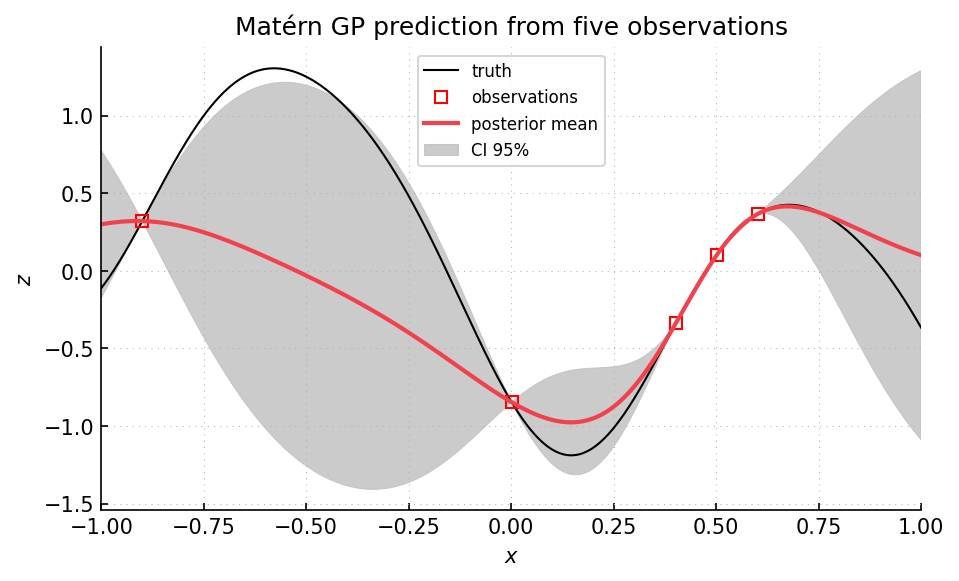
One-dimensional part: posterior means and variances on a regular grid. Red points are observations, the red curve is the posterior mean, and the shaded band is a pointwise 95 percent interval. The interval widens between observations and narrows at observed input locations. The full script also displays leave-one-out errors and reference-versus-prediction plots for the two-output case.
Source excerpt
# -----------------------------------
# Example 1: Single-output 1d problem
# -----------------------------------


# Define the problem
problem = gpc.ComputerExperiment(
    1,  # Input dimension
    [[-1], [1]],  # Input domain (box)
    single_function=gp.misc.testfunctions.twobumps,  # Test function
)

# Generate dataset
nt = 2000
xt = gp.misc.designs.regulargrid(problem.input_dim, nt, problem.input_box)
zt = problem(xt)

ind = [100, 1000, 1400, 1500, 1600]
ni = len(ind)
xi = xt[ind]
zi = problem(xi)

# Define the model, select parameters, predict, and draw conditional sample paths.
# Change model_choice to compare REML, REMAP, and ML.
model_choice = 1

if model_choice == 1:
    model = gpc.Model_ConstantMean_Maternp_REML(
        "1d_noisefree",
        problem.output_dim,
        mean_specification={"type": "constant"},
        covariance_specification={"p": 4},
    )
elif model_choice == 2:
    model = gpc.Model_ConstantMean_Maternp_REMAP(
        "1d_noisefree",
        problem.output_dim,
        mean_specification={"type": "constant"},
        covariance_specification={"p": 4},
    )
elif model_choice == 3:
    model = gpc.Model_ConstantMean_Maternp_ML(
        "1d_noisefree", problem.output_dim, covariance_specification={"p": 4}
    )

# model.select_params uses the criterion named by the model class.